
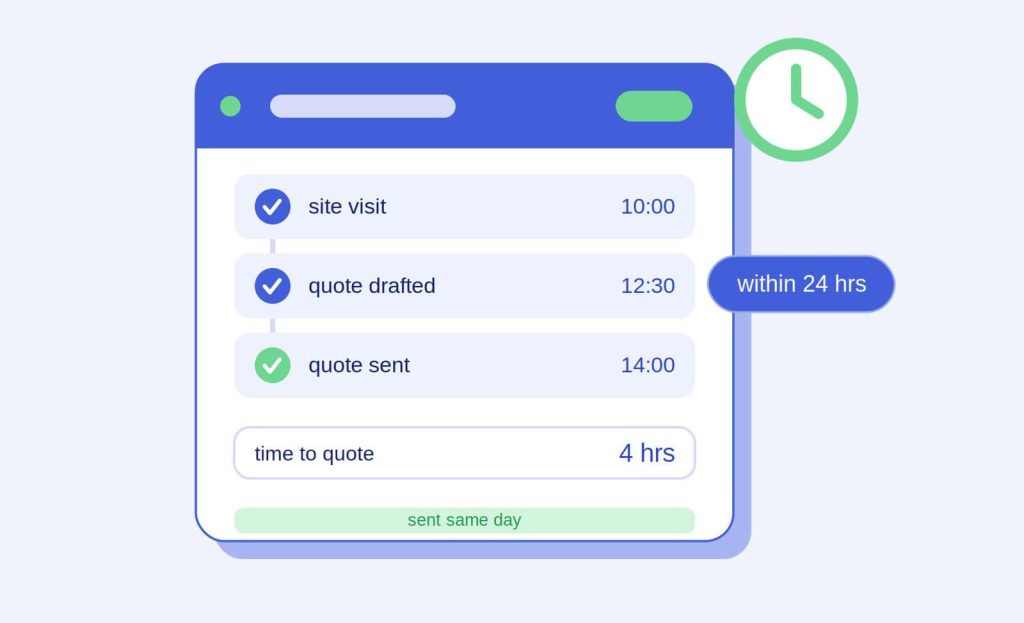
Quick answer: for straightforward jobs, aim to send the quote the same day or within 24 hours where practical. Complex commercial work may reasonably take several days because it needs supplier prices, engineering input or internal approval. The key is to remove avoidable admin and keep the customer informed if a detailed proposal will take longer.
Why quote turnaround time matters
Immediately after the site visit, the customer remembers the conversation and is actively thinking about the job. The surveyor also remembers the details.
As time passes, both sides lose momentum. Competitors may submit first, questions are forgotten and the quote becomes another item on an admin list.
There is no universal perfect time
A £300 domestic service and a £250,000 commercial project should not have the same turnaround target. Set service-level targets by job type.
A practical turnaround framework
| Job type | Good target |
|---|---|
| Simple domestic / repeat service | Same day where practical |
| Standard surveyed job | Within 24 hours |
| Detailed commercial proposal | 2-5 working days |
| Complex tender / supplier-dependent work | Communicate an agreed submission date |
These are operational targets, not rules. Accuracy and safety matter more than speed.
Why some quotes take days
The most common cause is not the calculation. It is fragmented information. Photos are on phones, notes are handwritten, access prices are in email and company documents are stored elsewhere.
By the time everything is assembled, the quote has become an administrative project.
Tell the customer when to expect it
If the proposal genuinely needs three days, say so before leaving site: “We’ll review the access price and send the full proposal by Thursday afternoon.”
Reliability can matter as much as raw speed.
How to achieve same-day quotes
Capture complete survey information
Use structured checklists, photos, measurements and voice notes.
Use approved scope templates
Do not write standard methodology from scratch every time.
Maintain current price data
Keep labour, equipment and common service rates accessible.
Automate proposal assembly
Reuse customer information, survey findings and company proof.
Use approval rules
Let standard work move quickly while unusual work routes to a senior reviewer.
Should you send a rough price first?
Sometimes. If a customer needs an indication before authorising a detailed survey or design process, a budget estimate can be useful as long as it is clearly labelled and does not create false certainty.
Do faster quotes win more jobs?
Speed alone does not make a poor offer better. But a fast, accurate and professional response can improve customer experience and reduce the opportunity for momentum to disappear.
The ideal is not “fast instead of good”. It is “good without unnecessary delay”.
How to measure your current performance
Track time from survey completion to proposal sent. Look at the median as well as the average, because a few very slow tenders can distort the number.
Then compare turnaround with win rate. You may discover that jobs quoted within 24 hours perform differently from jobs sent four days later.
What to do if the quote is delayed
Communicate. Send a short message confirming that the proposal is being prepared and when the customer will receive it. Silence can look like disorganisation.
How AI can shorten turnaround
AI can help convert notes into a structured scope, summarise site findings and draft customer-facing explanations. That can remove the blank-page problem after a survey.
The user still needs to confirm price, quantities and technical accuracy.
How SurvAIPro fits
SurvAIPro is being designed to allow the site survey to become the input for the proposal. Instead of returning to the office and reconstructing the visit, the user reviews an AI-assisted draft created from the information already captured.
For straightforward work, that creates the possibility of sending a professional proposal before the surveyor has moved on to the next job.
Build different service-level targets by job type
One mistake is setting a single turnaround promise for every opportunity. A better approach is to create categories. A repeat residential service with known pricing might have a same-day target. A surveyed commercial maintenance job might have a 24-hour or 48-hour target. A tender that depends on scaffold quotations, specialist subcontractors or manufacturer input might have a submission date agreed with the customer.
This makes performance easier to manage because staff know what “on time” means for each type of work. It also prevents simple quotes being held up by the same approval process used for complex projects.
Use automatic reminders internally
Many slow quotes are not technically difficult; they are simply forgotten. A quoting system should flag surveys that have not yet become proposals and show how long each opportunity has been waiting. Managers can then see bottlenecks before prospects start chasing.
A useful dashboard might show surveys completed today, proposals awaiting pricing, proposals awaiting approval and quotes not sent within the agreed service level. This turns quote speed into an operational metric rather than a vague ambition.
Do not forget follow-up speed
Fast quotation is only the first part of the sales process. Once a proposal is sent, track whether it has been viewed and schedule appropriate follow-up. A business that sends in two hours but waits three weeks to follow up can still lose momentum.
Frequently asked questions
Is 48 hours too long to send a quote?
Not necessarily. For detailed work, 48 hours may be fast. For a simple service, it may be slower than necessary. Set expectations according to complexity.
Should I send a quote on the same day?
If the survey information is complete and the price can be properly reviewed, same-day service can be an excellent customer experience.
What if I need supplier prices?
Tell the customer when the full proposal will be ready. You can also send a confirmation that the survey is complete and pricing is being finalised.
Final thought
The right target is the shortest turnaround that still allows an accurate, considered proposal. Most contractors can reduce that time significantly by fixing the information flow rather than asking staff to work faster.
SurvAIPro is being built around exactly that principle.