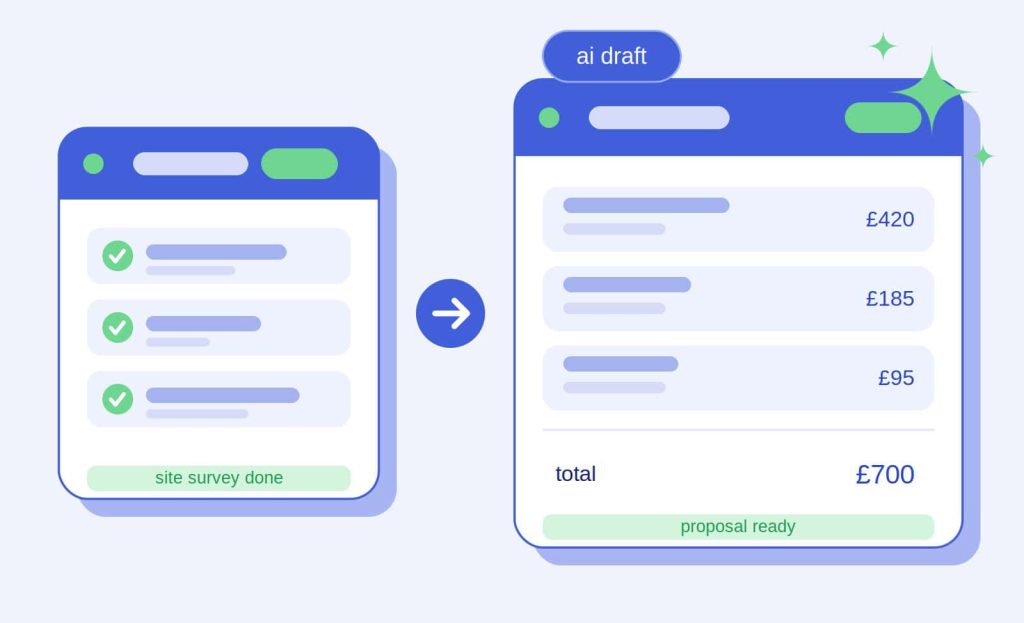
Quick answer: an AI survey-to-proposal workflow captures photos, video, notes, measurements and customer requirements during the site visit, then uses AI to organise that information into survey findings, recommended solution and scope. The contractor adds or reviews pricing, proof and terms before sending the finished proposal.
The traditional survey-to-quote problem
Site surveys contain most of the information needed for a proposal, but that information is rarely structured for reuse.
A surveyor might take 30 photos, record a video, write measurements in notes and discuss the solution with the customer. Back at the office, they open a blank quotation and start again.
That duplicate effort is exactly where AI can help.
Step 1: Capture the customer’s objective
Before focusing on technical detail, record why the customer wants the work. Are they preparing a building for sale, dealing with recurring water ingress, improving appearance, satisfying an insurer or reducing maintenance?
This gives the proposal commercial context.
Step 2: Capture photos and video
Photographs document specific defects and work areas. Video is useful for explaining context quickly: access, layout, height, condition and the surveyor’s thought process.
Good AI input starts with good site capture.
Step 3: Record voice notes
A surveyor can talk naturally: “The west elevation has heavy staining. Recommend low-pressure steam cleaning. MEWP can set up in rear car park but loading bay must remain accessible.”
AI can then help convert that narrative into structured proposal sections.
Step 4: Extract the survey findings
The system can group observations into customer-friendly findings. For example, organic growth, coating failure, damaged sealant, blocked drainage or access constraints.
The surveyor reviews the interpretation to ensure it is accurate.
Step 5: Draft the recommended solution
Using the survey notes and approved company methodologies, AI can help explain the recommended solution in plain English.
The system should not invent a method simply because it sounds plausible. Where data is missing, it should ask the user.
Step 6: Build the scope of works
Convert the solution into clear deliverables: areas, preparation, access, method, protection, waste, quality checks and exclusions.
This scope should be detailed enough for both the customer and the operations team.
Step 7: Add relevant proof
The software can match the job to appropriate case studies, testimonials, accreditations and insurance documents from the company library.
A roofing prospect should see roofing proof. A data-centre customer should see critical-environment experience. Relevance matters more than volume.
Step 8: Price the job
AI can surface historical comparables and standard cost components, but the estimator should confirm quantities, production assumptions, access, supplier costs and margin.
Over time, closed-loop data from won and completed jobs can make pricing support more useful.
Step 9: Generate the proposal
The final proposal can follow a high-conversion structure:
- Customer requirements
- Survey findings
- Why the issue matters
- Recommended solution
- Why choose us
- Similar projects
- Scope
- Programme
- Investment
- Supporting documents
- Acceptance
Step 10: Add digital acceptance and payment
Residential customers can be shown the correct deposit requirement based on company settings. Commercial customers can be asked for a PO number. Both can sign digitally.
This turns the proposal from a static PDF into an action page.
Step 11: Reuse the data after the job is won
The accepted proposal should not be the end of the workflow. The same information can help create the job record, invoice and first draft of RAMS, then feed performance and profitability information back into future pricing.
What AI should not do
- Guess critical measurements
- Invent access conditions
- Approve its own safety controls
- Change commercial terms without permission
- Send a proposal without user review unless the business has deliberately configured a controlled workflow
Why this matters for scaling service businesses
When quoting depends on one experienced owner manually writing every proposal, the business has a capacity ceiling.
A structured AI-assisted workflow makes company knowledge more accessible to the team while preserving approval rules.
How SurvAIPro is being built
SurvAIPro is specifically focused on the gap between site survey and customer proposal. The aim is to let users capture the job once and reuse that information through the rest of the sales process.
The platform is being designed for service businesses such as exterior cleaning, roofing, pest control, landscaping, facilities management, building maintenance, drainage, HVAC and similar sectors where surveying comes before quoting.
Frequently asked questions
Can AI create a proposal from a video?
Modern multimodal AI can help interpret video and audio content, but the user should verify important technical facts before issue.
Can AI identify the price from photos?
Photos can provide context, but price usually depends on dimensions, labour, access, materials, programme and company margin rules. Treat image analysis as one input, not the whole estimate.
Can the proposal be sent before leaving site?
For straightforward work with complete data and controlled pricing, yes. More complex projects may still need office or management review.
Can the same information create RAMS?
It can help create the draft because site, scope and equipment data already exists, but competent safety review is still required.
Final thought
AI is most valuable when it removes duplicate work while keeping human expertise in control.
The future workflow is not “AI guesses the job”. It is “the surveyor captures the job once, AI organises it, and the business reviews and sends a better proposal faster.”