
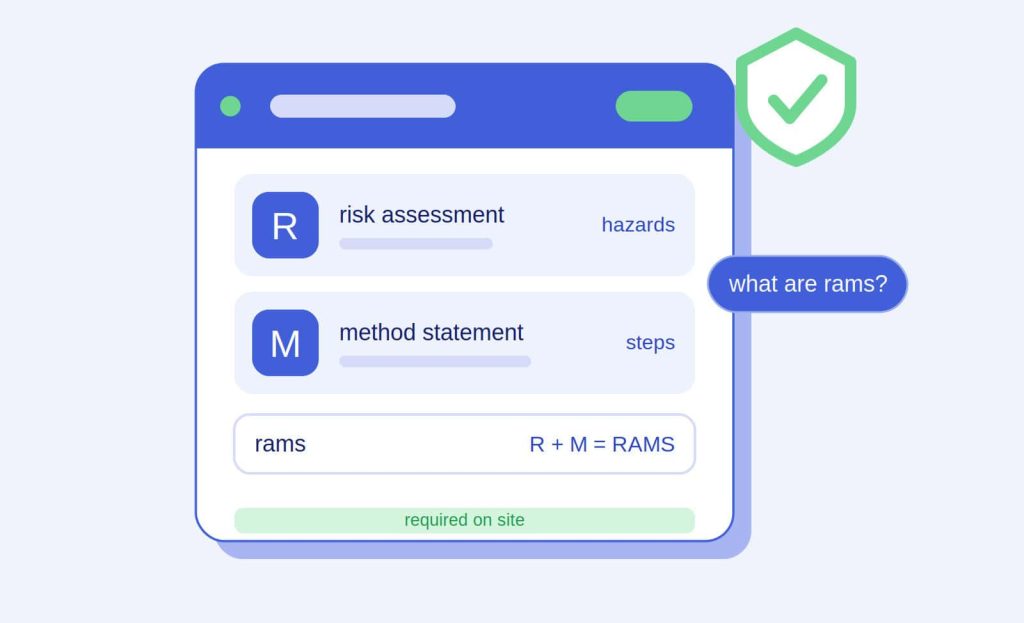
Quick answer: RAMS stands for Risk Assessments and Method Statements. A risk assessment identifies hazards, who could be harmed and the controls needed. A method statement explains how the work will be carried out safely in a logical sequence. RAMS are widely used by contractors, particularly for commercial, construction and higher-risk work.
What does RAMS mean?
RAMS is a common industry abbreviation for a combined set of risk assessments and method statements. The documents are normally used to plan work, communicate controls and show clients or principal contractors how the task will be carried out.
The two parts perform different functions and should not be treated as interchangeable.
What is a risk assessment?
A risk assessment considers the hazards associated with the work, who may be harmed and what controls are required. HSE guidance says a simple risk-assessment record can include who might be harmed, existing controls, further actions, who will complete them and when.
HSE also warns businesses not to simply copy a generic example and add their company name. The hazards and controls need to reflect the actual business and work.
What is a method statement?
A method statement describes how the work will be carried out safely, usually in a logical sequence. HSE describes method statements as a practical way to plan, manage and monitor construction work and communicate the safe system of work.
For some activities, such as demolition, dismantling or structural alteration, written arrangements are specifically required. For many other activities, method statements are not a standalone legal requirement but are widely used as an effective management tool.
When are RAMS needed?
There is no single rule saying every job must have a document titled “RAMS”. The requirement depends on the work, legal duties, client arrangements and risk.
In practice, RAMS are commonly requested for:
- Construction sites
- Commercial properties
- Work at height
- Roof work
- MEWP operations
- Rope access
- Use of hazardous substances
- Demolition and structural work
- Work in occupied environments
- Facilities-management contracts
What should good RAMS contain?
Content should reflect the task, but common sections include:
- Project and site details
- Scope of work
- People responsible
- Competence and training
- Plant and equipment
- Hazards
- Risk ratings
- Control measures
- PPE
- Sequence of work
- Access and exclusion arrangements
- Emergency procedures
- Environmental controls
- COSHH information where relevant
- Sign-off and briefing records
Why site-specific RAMS matter
A generic risk assessment may identify common hazards, but site conditions change the risk. Access may be different, members of the public may be present, rooflights may be fragile, parking restrictions may change MEWP positioning or another contractor may be working in the same area.
The document therefore needs competent review against the actual site.
RAMS for work at height
HSE guidance for work at height emphasises risk assessment, appropriate precautions and planning. It notes that method statements are widely used in construction to manage the work and communicate what is required.
For roof work, HSE specifically highlights planning, competence, safe access, edges and fragile surfaces.
Who should prepare RAMS?
The employer or contractor responsible for the work must ensure suitable risk management. The person preparing or approving the documentation needs enough knowledge and experience to understand the hazards and controls.
Software can help structure and draft the document, but it cannot replace competent site-specific judgement.
What is the difference between RAMS and COSHH?
COSHH assessments deal specifically with hazardous substances and the risks from exposure. A RAMS pack may refer to or include relevant COSHH assessments, but they are not the same document.
Can AI generate RAMS?
AI can help create a first draft from job information that already exists: site address, scope, equipment, access method, known hazards and sequence of work.
That can remove a significant amount of repetitive administration, particularly where the same information has already been captured during the site survey.
However, AI-generated RAMS should be clearly treated as a draft. A competent person must review the hazards, controls, equipment, rescue arrangements and site conditions before approval and issue.
How SurvAIPro approaches RAMS
SurvAIPro is being designed so that information captured during the survey can help populate a draft RAMS after the work is won.
The principle is simple: if the system already knows the site, scope, access method and proposed equipment, the user should not have to type all of that information again.
The final responsibility remains with the contractor and competent reviewer.
RAMS checklist before issue
- Correct project and site
- Scope matches what has actually been sold
- Hazards are site-specific
- Controls follow the hierarchy of control
- Access and equipment are correct
- Workers are competent
- Emergency arrangements are suitable
- Other contractors and the public have been considered
- COSHH assessments are attached where needed
- Document has been reviewed and approved
- Workforce is briefed before starting
Frequently asked questions
Are RAMS a legal requirement?
Risk assessment duties are legal requirements. Method statements are required in writing for certain types of work and widely used for many others. The exact documentation needed depends on the work and legal context.
Can I copy old RAMS?
You can reuse appropriate company knowledge, but the new job must be reviewed for its own hazards and conditions. HSE explicitly warns against simply copying generic risk assessments.
Do domestic jobs need RAMS?
Risk still needs to be managed. Whether a formal RAMS document is required depends on the task, business arrangements and client requirements.
Final thought
RAMS are most useful when they are treated as a planning and communication tool, not paperwork created simply to satisfy a client.
SurvAIPro is being built to reduce the repetitive admin involved in creating the first draft while keeping competent-person review at the centre of the process.
Sources: UK Health and Safety Executive guidance on risk assessment templates, construction method statements, work at height and roof work.