
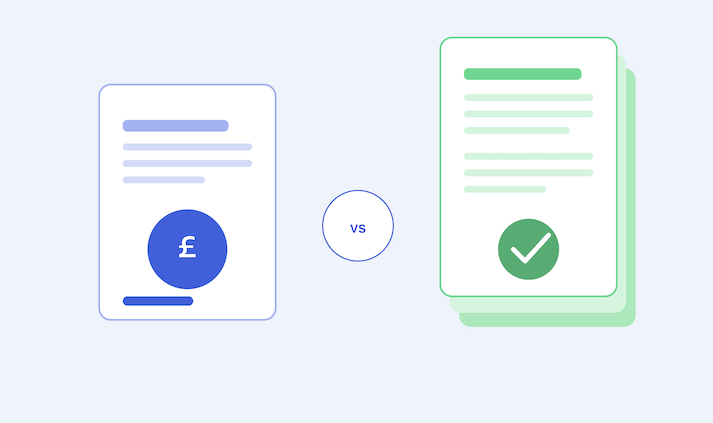
Quick answer: In the quote vs proposal debate, a quote mainly tells a customer what you will do and what it will cost. A proposal goes further: it explains the customer’s problem, your recommended solution, the evidence behind your recommendation, why your business is a good fit, what is included, the investment and the next step. For higher-value or competitive work, that extra context can make the buying decision easier.
Quote vs proposal: what’s the difference?
Before comparing the two side by side, it helps to define each one on its own. Understanding the quote vs proposal difference starts with knowing what each document is actually for.
What is a quote?
A quote is a formal price offered for a defined piece of work. In most service businesses it normally includes a description of the work, quantities or line items, price, VAT where applicable, validity period, payment terms and basic conditions.
Quotes are useful because they are fast and clear. For simple or low-risk jobs, that may be all the customer needs. If someone already trusts your business and is asking for a straightforward price, a concise quote can be perfectly appropriate.
The weakness is that a quote can leave the customer comparing suppliers almost entirely on price. If three companies send a similar list of works and three different totals, the cheapest number can become the easiest way to decide.
What is a proposal?
A proposal is a sales document as well as a commercial document. It does not just state the price. It helps the customer understand why the recommended solution is appropriate and why your company is capable of delivering it.
A strong contractor proposal can include the customer’s objectives, survey findings, photographs, recommended methodology, scope of works, exclusions, programme, examples of similar projects, testimonials, accreditations, insurance information, pricing, acceptance and payment options.
This matters because many customers are not technical experts. They may not know why one contractor recommends steam cleaning rather than pressure washing, why one roofing repair method is more appropriate than another, or why access costs differ. A proposal gives you room to explain the logic rather than simply displaying the result.
Quote vs proposal: the practical difference
| Quote | Proposal |
|---|---|
| Focuses on price and scope | Focuses on problem, solution, proof, scope and price |
| Usually short | Can be visual and more detailed |
| Best for simple work | Best for higher-value, competitive or complex work |
| Often transactional | Designed to build confidence |
| Can encourage price comparison | Helps customers compare overall value |
This table sums up the quote vs proposal comparison at a glance, but the practical difference matters most once you’re deciding which document to send for a specific job.
Which one is more likely to win work?
There is no document format that guarantees a sale. Price, timing, reputation, relationship, availability and procurement rules all affect the outcome. However, when the customer needs confidence as well as a price, a well-built proposal has more opportunities to influence the decision than a basic quote does.
It can show that you listened during the survey, understood the risks, have relevant experience and have thought through delivery. That can be especially valuable when you are not the cheapest contractor.
The aim is not to add ten pages of corporate waffle. The aim is to answer the questions the buyer is already asking: Do they understand the job? Can they solve it? Have they done similar work? What exactly am I buying? What could go wrong? What happens next?
The ideal proposal structure for service businesses
1. Our understanding of your requirements
Open with the customer, not your company history. Summarise what they need and the outcome they are trying to achieve. This immediately shows that the proposal is specific to them.
2. Survey findings
Use the actual information gathered on site. Include photographs, observations, measurements and any limitations discovered during the survey.
3. Why the issue matters
Where relevant, explain the consequences of leaving the problem unresolved. Keep this factual and proportionate. The purpose is to provide context, not create unnecessary fear.
4. Recommended solution
Explain how you intend to solve the problem, including the proposed method, access, equipment, sequence and quality-control approach.
5. Why choose us
Only after demonstrating understanding should you talk about your company. Use relevant proof: years of experience, specialist competence, accreditations, insurance, reviews and sector experience.
6. Similar work
A relevant case study can be more persuasive than generic marketing copy. Show a similar challenge, what you did and the result.
7. Scope, exclusions and assumptions
Be precise. Clear scopes reduce misunderstandings, protect margin and make handover to operations easier.
8. Investment
Present the price clearly. If there are genuine optional levels of service, present them logically rather than burying the buyer in alternatives.
9. Acceptance and next steps
Make it easy to move forward with digital acceptance, signature, PO number capture for commercial work and deposit collection where appropriate.
Why basic quotes often struggle on higher-value work
A basic quote assumes the customer already understands the value behind your price. In reality, they may only see a total at the bottom of the page. If your price is £12,500 and another supplier is £10,000, your customer needs a reason to understand the £2,500 difference.
A proposal can make visible what would otherwise remain invisible: planning, specialist access, competent labour, protection measures, warranty, reporting, supervision, insurance, case studies and quality assurance.
That does not mean artificially inflating the document. It means communicating the parts of your service that the customer genuinely receives — which is really the heart of the quote vs proposal decision.
Can a better proposal help you charge more?
A stronger proposal does not automatically let you increase prices. What it can do is make value easier to understand. When the customer can see the quality, process, proof and reduced risk behind your offer, the decision is less likely to be based on the headline number alone.
This is particularly important for service businesses that compete against lower-cost operators. If your business has stronger systems, training, insurance, equipment, experience or guarantees, your proposal should make those differences visible.
How AI can turn a site survey into a proposal
Traditionally, the survey and the proposal are two separate pieces of work. A surveyor takes photographs and notes on site, then later recreates that information in Word, Excel, a CRM or job-management system.
SurvAIPro is being developed around a different workflow: capture the job once, then use that survey information to help create the customer-facing proposal. Photos, videos and notes can inform the survey findings, scope, recommended solution and supporting content, subject to user review.
The goal is not to remove judgement from the estimator. It is to remove unnecessary retyping and formatting so the estimator can spend more time on the commercial and technical decisions that actually require experience.
When should you use a quote instead of a proposal?
Use a simple quote when the job is straightforward, the customer already understands the service, the value is low, there is little technical differentiation or the customer explicitly asks for a price only.
Use a proposal when the work is competitive, bespoke, high-value, technical, commercial, visually important, risk-sensitive or when you need to explain why your solution is different. Most businesses end up needing both, which is exactly why understanding quote vs proposal use cases matters.
Frequently asked questions
Is a proposal legally binding?
A proposal can become contractually significant once accepted, depending on its wording, terms and the circumstances. Businesses should ensure their terms, acceptance process and contractual documents are appropriate for the work they perform.
Can I send both a quote and a proposal?
Yes. Many businesses include the formal quotation or pricing schedule inside the wider proposal. This provides both sales context and a precise commercial offer.
How long should a proposal be?
Long enough to help the buyer make a decision, but no longer. A £500 domestic job may need only a few sections. A £100,000 commercial project may require a significantly more detailed submission.
Should I put my company information first?
Usually not. Start with the customer’s needs and the problem you are solving. Your credentials become more persuasive after you have demonstrated that you understand the job.
Final thought
The difference between a quote and a proposal is simple: a quote communicates a price; a proposal helps communicate a decision. Once you’re clear on the quote vs proposal difference, choosing the right document for each job becomes far easier.
For contractors and service businesses, the best approach is often to make the proposal do the selling after the surveyor has left site.
SurvAIPro is being built to help service businesses turn site surveys, photos, videos and notes into professional proposals faster – reducing admin while giving customers a clearer reason to choose you.